





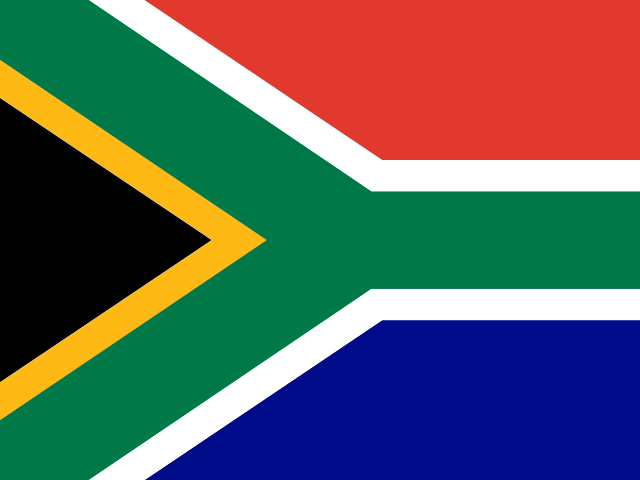
South Africa Corruption Index
Price
Price
41 Points
Change +/-
+0 Points
Percentage Change
+0.00 %
The current value of the Corruption Index in South Africa is 41 Points. The Corruption Index in South Africa decreased to 41 Points on 1/1/2025, after it was 41 Points on 1/1/2024. From 1/1/1996 to 1/1/2025, the average GDP in South Africa was 45.68 Points. The all-time high was reached on 1/1/1996 with 56.80 Points, while the lowest value was recorded on 1/1/2011 with 41.00 Points.
The current value of Corruption Index in South Africa is 41 Points. Corruption Index in South Africa decreased to 41 Points from 41 Points.Corruption Index in South Africa averaged 45.68 Points from 1/1/1996 until 1/1/2025.The all-time high was 56.80 Points (1/1/1996)and the record low was 41.00 Points (1/1/2011).
Corruption Index
Corruption Index
3 Years
5 Years
10 Years
25 Years
Max
Corruption Index History
| Date | Value |
|---|---|
| 41 Points | |
| 41 Points | |
| 41 Points | |
| 43 Points | |
| 44 Points | |
| 44 Points | |
| 44 Points | |
| 43 Points | |
| 43 Points | |
| 45 Points |
Similar Macro Indicators to Corruption Index
Corruption Rank
Annually
Fiscal Expenditure
Monthly
Government budget
Annually
Government Debt to GDP Ratio
Annually
Government Spending
Quarter
Military expenditures
Annually
Public debt
Quarter
Public revenue
Monthly
Value of the State Budget
Monthly
Corruption Index
The Corruption Perceptions Index assesses and ranks countries and territories according to the perceived level of corruption within their public sectors. Each nation or territory is assigned a score that reflects this perception, ranging from 0, indicating a high level of corruption, to 100, signifying a very clean public sector.
Macro pages for other countries in Africa













What is Corruption Index?
The Corruption Index stands as a pivotal component in the analysis and understanding of macroeconomic environments and their intricate dynamics. In essence, the Corruption Index is a quantifiable measure used to assess the level of corruption perceived within the public sector of various countries around the world. This crucial indicator provides invaluable insights into the governance quality and ethical standards prevalent in different nations, thereby influencing foreign investments, economic policies, and overall economic health. When discussing corruption in an economic context, it is indispensable to understand its multifaceted nature. Corruption often manifests in the form of bribery, embezzlement, nepotism, and favoritism, among other unethical practices, and its repercussions can be significantly detrimental to the economic fabric of a country. The Corruption Index encapsulates these elements into a coherent and standardized measure, showcasing the perceived level of corruption across various sectors. At Eulerpool, we recognize the profound impact that corruption has on economic stability and growth. By providing comprehensive and meticulously curated macroeconomic data, we aim to offer our users an analytical edge in assessing corruption levels and their implications on economic landscapes. The Corruption Index is instrumental in both academic research and practical applications, serving as a critical tool in policy formulation, investment decisions, and strategic planning. The methodology behind the Corruption Index involves aggregating expert assessments and opinion surveys. Renowned organizations like Transparency International spearhead the collection and analysis of data, ensuring that the index is both robust and comprehensive. The resultant score ranges typically from 0 to 100, with higher scores indicating lower levels of perceived corruption. These scores are essential for understanding the relative ethics and governance efficacy of different countries, making the Corruption Index an indispensable reference point for economists, investors, and policymakers alike. A high Corruption Index score reflects a transparent, accountable, and well-governed public sector, fostering trust and reliability essential for economic prosperity. Countries that score well on the Corruption Index generally exhibit stronger economic performance, attracting higher levels of foreign direct investment (FDI) and fostering sustainable economic growth. This is attributed to the perceived stability and predictability that comes with lower corruption levels, which in turn, engenders a conducive environment for business operations and economic activity. Conversely, a low Corruption Index score signifies pervasive corruption, which can lead to numerous adverse economic consequences. High corruption levels often correlate with inefficiencies in public spending, misallocation of resources, and a fraught business environment. Such conditions deter foreign investments, drain public resources, and hinder economic development. Furthermore, corruption undermines the rule of law and breeds disillusionment among the populace, exacerbating social inequalities and economic disparities. At Eulerpool, the incorporation of the Corruption Index into our extensive database enhances the depth and breadth of our macroeconomic analysis. By offering this vital data, users can delve into comparative studies, historical analyses, and trend observations, which are crucial for informed decision-making. Whether it is for academic research, government policy-making, or private sector investment strategies, the Corruption Index provides a granular understanding of the ethical climate and governance standards across different regions. In the realm of macroeconomic forecasting and risk assessment, the Corruption Index plays a crucial role. Analysts and investors utilize this index to gauge potential risks associated with corruption, making it an essential element in country risk assessments. Assessing the corruption levels aids in determining the viability and potential return on investment within specific markets. Furthermore, understanding the corruption landscape allows for the anticipation of policy shifts, regulatory changes, and potential social unrest, thereby facilitating more strategic and informed economic decisions. The utility of the Corruption Index extends beyond just the public sector. The private sector also relies heavily on the perceptions of corruption as a determinant of market entry, operational strategies, and competitive positioning. Multinational corporations, for instance, may utilize the Corruption Index to assess the feasibility of expanding their operations in countries with lower corruption levels, where the risk of legal and operational complications is minimized. Moreover, the Corruption Index is an indispensable tool for international bodies and non-governmental organizations (NGOs) involved in developmental aid and economic assistance. By understanding the corruption dynamics within a country, these organizations can tailor their aid programs to be more effective and impactful, ensuring that resources are judiciously allocated and that their efforts yield sustainable development outcomes. In conclusion, the Corruption Index is a cornerstone of macroeconomic analysis, providing an essential lens through which the ethical and governance standards of countries can be understood and evaluated. At Eulerpool, we are committed to delivering precise and comprehensive macroeconomic data, and the inclusion of the Corruption Index is a testament to our dedication to enhancing the analytical capabilities of our users. By leveraging this critical index, economists, policymakers, investors, and researchers can gain unparalleled insights into the economic implications of corruption, thereby fostering a more informed and strategic approach to economic decision-making.
Corruption Index South Africa — FAQ
What is the current Corruption Index in South Africa?
The current Corruption Index in South Africa is 41 Points as of 1/1/2025.
How has the Corruption Index in South Africa changed recently?
The Corruption Index in South Africa decreased from 41 Points (1/1/2024) to 41 Points (1/1/2025).
What is the all-time high for Corruption Index in South Africa?
The all-time high for Corruption Index in South Africa was 56.80 Points, recorded on 1/1/1996.
What is the all-time low for Corruption Index in South Africa?
The all-time low for Corruption Index in South Africa was 41.00 Points, recorded on 1/1/2011.
What is the historical average of Corruption Index in South Africa?
The historical average of Corruption Index in South Africa is 45.68 Points, calculated over the period from 1/1/1996 to 1/1/2025.
Where does the Corruption Index data for South Africa come from?
The Corruption Index data for South Africa is sourced from Transparency International and published on Eulerpool.
Key Figures
All Macro Indicators for South Africa
More tools & analysis
Free tools and market data from Eulerpool.
Screener
Screen 20,000+ stocks worldwide across 1,000,000+ data points.
Insider Tracker
Track insider buys and sells in real time.
Superinvestors
Track portfolios of the world's greatest investors
Dividend Calendar
Plan your passive income with dividend payout dates.
Earnings Calendar
All quarterly earnings results at a glance.
Economic Calendar
Economic events and data releases from 200+ countries.
Congress Tracker
STOCK Act disclosures from U.S. Congress members
Fear & Greed Index
Market Sentiment Indicator
Crypto Fear & Greed Index
Crypto Market Sentiment Indicator
Ideas
Curated stock lists by strategy, index, and country.
Sectors
Top stocks sorted by industry and sector.
Countries
Stock markets and top companies by country.
Strategy
Proven investment strategies with historical returns.
Index
Performance and composition of major stock indices.
Glossary
Comprehensive stock market dictionary for financial and stock terms
Blog
News, partnerships, and product announcements